
A new review, published in Therapeutic Advances in Psychopharmacology, argues that while psychiatric drug withdrawal has been known to affect people who are trying to reduce their psychiatric drug use, psychiatrists and researchers have largely ignored this issue for decades.
The authors, Peter Groot and Jim van Os, present compelling data showing that persons who would like to taper or come off psychiatric drugs receive little or no support. Often physicians lack training on psychiatric drug tapering, pharmaceutical companies do not produce dosages that would facilitate slow tapering, and insurance companies refuse to pay for tapering regimes. They argue that service-users’ first-hand experiences are essential for developing guidelines to support better those who would like to taper or come off psychiatric drugs while using tapering strips, tools to monitor withdrawal symptoms, and shared decision-making models.
“Ironically and sadly,” Groot and van Os write, “what we see here is that the ‘evidence-based model’ of medical science has led to a culture of substantially ignoring patient experiences.”
Read More
We would like to describe a case of clozapine intoxication as a result of COVID-19 infection. As far as we are aware, an example of this has not yet been described.
In patients treated with clozapine, COVID-19 infection may result in complications including an increased risk of pneumonia, clozapine toxicity, and disruption to clozapine treatment by COVID-19 induced lymphopenia. 1–3
Patients treated with clozapine are at greater risk of pneumonia and may, therefore, be at increased risk of deterioration during COVID-19 infection. 1 De Leon et al offer a thorough review of the risk of pneumonia and clozapine intoxication associated with infection, recommending clozapine dose reduction during fever and/or pneumonia including in the context of COVID-19. 2 This risk of intoxication is reflected in the RCPsych (UK) policy on clozapine and blood dyscrasias in patients with COVID-19, where it is advised that clozapine levels are taken in all patients with suspected symptoms of COVID-19. 3
Read More
Background
Non-interventional post-marketing studies (NIPMSs) sponsored by pharmaceutical companies are controversial because, while they are theoretically useful instruments for pharmacovigilance, some authors have hypothesized that they are merely marketing instruments used to influence physicians’ prescription behavior. So far, it has not been shown, to our knowledge, whether NIPMSs actually do have an influence on prescription behavior. The objective of this study was therefore to investigate whether physicians’ participation in NIPMSs initiated by pharmaceutical companies has an impact on their prescription behavior. In addition, we wanted to analyze whether specific characteristics of NIPMSs have a differing impact on prescription behavior.
Methods and findings
In a retrospective 2-armed cohort study, the prescription behavior of 6,996 German physicians, of which 2,354 had participated in at least 1 of 24 NIPMSs and 4,642 were controls, was analyzed. Data were acquired between 6 October 2016 and 8 June 2018. Controls were matched by overall prescription volume and number of prescriptions of the drug studied in the NIPMS in the year prior to the NIPMS. Primary outcome was the relative rate of prescriptions of the drug studied in the NIPMS by participating physicians compared to controls during the NIPMS and the following year. Secondary outcomes were the proportion of prescriptions of the studied drug compared to alternative drugs used for the same indication, the revenue generated by these prescriptions, and the association between the marketing characteristics of the NIPMS and prescription habits. Of the 24 NIPMSs, the 2 largest drug groups studied were antineoplastic and immunomodulatory agents (7/24, 29.2%) and agents for the nervous system (4/24, 16.7%). Physicians participating in an NIPMS prescribed more of the studied drug during and in the year after the NIPMS, at a relative rate of 1.08 (95% CI 1.07–1.10; p < 0.001) and 1.07 (95% CI 1.05–1.09); p < 0.001), respectively. Participating physicians were more likely than controls to prescribe one of the studied drugs rather than alternative drugs used for the same indication (odds ratio 1.04; 95% CI 1.03–1.05). None of the marketing characteristics studied were significantly associated with prescription practices. The main limitation was the difficulty in controlling for confounders due to privacy laws, with a resulting lack of information regarding the included physicians, which was mainly addressed by the matching process.
Conclusions
Physicians participating in NIPMSs prescribe more of the investigated drug than matching controls. This result calls the alleged non-interventional character of NIPMSs into question and should lead to stricter regulation of NIPMSs.

ACTIVITY GOAL
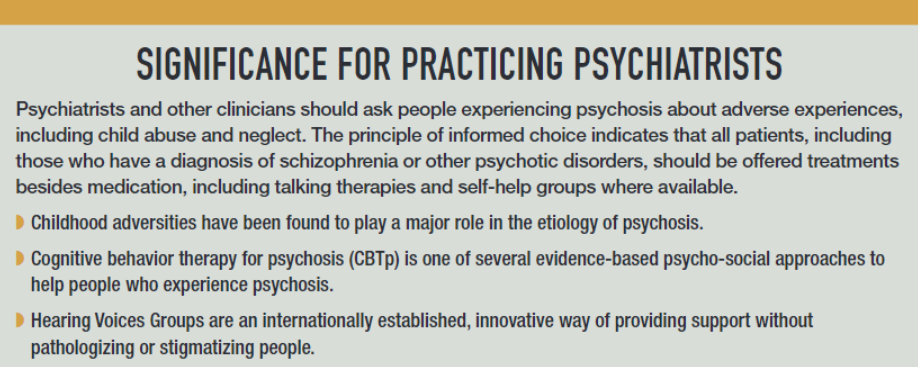
The goal of this activity is to understand that childhood adversities can play a causal role in the development of psychosis and that psycho-social interventions can be helpful when this is the case, including Cognitive Behavioral Therapy for Psychosis and Hearing Voices Groups.
LEARNING OBJECTIVES
After engaging with the content of this CME activity, you should be better prepared to:
TARGET AUDIENCE
This continuing medical education (CME) activity is intended for psychiatrists, psychologists, primary care physicians, physician assistants, nurse practitioners, and other health care professionals who seek to improve their care for patients with mental health disorders.
ACCREDITATION/CREDIT DESIGNATION/FINANCIAL SUPPORT
This activity has been planned and implemented in accordance with the accreditation requirements and policies of the Accreditation Council for Continuing Medical Education (ACCME) through the joint providership Physicians’ Education Resource®, LLC and Psychiatric Times. Physicians’ Education Resource®, LLC is accredited by the ACCME to provide continuing medical education for physicians
Physicians’ Education Resource®, LLC designates this enduring material for a maximum of 1.5 AMA PRA Category 1 Credits™. Physicians should claim only the credit commensurate with the extent of their participation in the activity.
This activity is funded entirely by Physicians’ Education Resource®, LLC. No commercial support was received.
OFF-LABEL DISCLOSURE/DISCLAIMER
This CME activity may or may not discuss investigational, unapproved, or off-label use of drugs. Participants are advised to consult prescribing information for any products discussed. The information provided in this CME activity is for continuing medical education purposes only and is not meant to substitute for the independent clinical judgment of a physician relative to diagnostic or treatment options for a specific patient’s medical condition.
The opinions expressed in the content are solely those of the individual faculty members and do not reflect those of Physicians’ Education Resource®, LLC.
FACULTY, STAFF, AND PLANNERS’ DISCLOSURES
The authors, the peer reviewer, and the staff members of Physicians’ Education Resource®, LLC and Psychiatric Times have no relevant financial relationships with commercial interests.
For content-related questions email us at [email protected]; for questions concerning the accreditation of this CME activity or how to claim credit, please contact [email protected] and include Traumas, Adversities, and Psychosis: Investigating Practical Implications in the subject line.
HOW TO CLAIM CREDIT
Once you’ve read the article, please use the following URL to evaluate and request credit https://education.gotoper.com/activity/ptcme20jul. If you do not already have an account with PER® you will be prompted to create one. You must have an account to evaluate and request credit for this activity.
Premiere Date: July 20, 2020
Expiration Date: February 20, 2022
This activity offers CE credits for:
All other clinicians either will receive a CME Attendance Certificate or may choose any of the types of CE credit being offered.
The notion that bad things happen that can drive us “crazy” has been with us for centuries. The first meta-analysis of research on the topic did not appear, however, until 2012.1 It involved the 41 most robust studies at the time, including 18 comparisons of patients with psychosis and control participants without psychiatric disorders, 10 prospective studies, and 8 general population surveys. The researchers found that psychosis was 2.8 times more likely to develop in people who had suffered one or more childhood adversities. The odds ratios for 6 specific adversities were: sexual abuse, 2.4; physical abuse, 2.9; emotional abuse, 3.4; neglect, 2.9; bullying, 2.4; parental death, 1.7. Dose response was seen in 9 of the 10 studies that tested for it. For example, a survey of 8580 people found that those subjected to one form of adversity were 1.7 times more likely to have a diagnosis of a psychotic disorder, compared with 18 times more likely for 3 adversities, and 193 times for 5.2
The biological, social, and psychological mediators of the relationship have been explored.3,4 The content of hallucinations and delusions is often related, directly or metaphorically, to childhood traumas (Table 1).5-8 The range of childhood adversities that have been found to play a causal role includes sexual abuse, incest, physical abuse, neglect, poverty, loss (eg, of parents), bullying, being fostered/adopted, or a combination of any of these.1-7,9,10 Relationships between specific traumas or adversities and specific psychosis symptoms have been investigated.10,11 The Traumagenic Neurodevelopmental Model of psychosis maps the similarities between the brains of traumatized children and adults diagnosed with schizophrenia.4

Ian Tucker is a professor and director of impact and innovation in the school of psychology at the University of East London. His expertise is in digital media, emotion, and mental health, he has published over 45 articles and book chapters and has a monograph book entitled Social Psychology of Emotion. He is currently authoring an Emotion in the Digital Age monograph for Routledge’s Studies in Science, Technology, and Society series while working on several projects involving technology and mental health.
In this interview, we discuss how Ian became interested in studying relationships between technology, emotion, and mental health. He addresses some limitations of traditional psychological approaches to these topics and overviews some of his main areas of concern with how digital technology is being used to track people’s emotions and regulate their mental health.
Drawing on philosophers like Gilbert Simondon and Henri Bergson, Ian also explores how digital technologies are being used within peer-to-peer communities to create information archives about experiences with distress and medication in ways that offer collective support.
The transcript below has been edited for length and clarity. Listen to the audio of the interview here.
Read MoreThe neuroleptic tranquilizers commonly referred to as “antipsychotics” are often used as a first-line treatment for those deemed “at risk for psychosis,” as treatment providers attempt to stave off the worsening of psychotic symptoms associated with schizophrenia. However, there is little evidence that this approach is effective, and the drugs are associated with many harmful effects.
In a new study, published in the Australian & New Zealand Journal of Psychiatry, researchers wanted to investigate whether antipsychotics might prevent “conversion to psychosis” in people who were identified as being at “clinical high risk (CHR) of psychosis.”
The researchers found that antipsychotics were consistently associated with worse outcomes—higher rates of “conversion to psychosis” were found in those who took the drugs, those who had multiple prescriptions, and those who took a higher dose of the drugs.
“Administration of antipsychotics to CHR patients is potentially harmful with no preventive benefits. We do not recommend antipsychotic treatment for CHR individuals, which is practiced widely in China, and strongly advise caution if these drugs are used.”
Read MoreThe expert inputs Managing Efexor and SSRI Withdrawal and Protracted Antidepressant Withdrawal to and comments on H’s case Side Effexor Withdrawal have been wonderful to get and hopefully will be a resource for others.
H’s original problem and the idea of a commentary came about because 3 of us considered her case in response to a request she sent to RxISK for a consultation and we all figured this was not a problem that had any easy answers. Getting and giving H a range of views seemed the best way forward. It risked leaving her more hopeless if there were no answers, but a recognition of her difficulties and that they are widely shared might help nevertheless.
I’ve seen almost no more correspondence from H than readers of this blog have seen. My sense is that she is a competent woman, perhaps very competent. Her difficulties getting off Efexor, or anything that happened before leading her to be on it, don’t change my view.
I have known a lot of extraordinarily competent people have problems getting off these drugs – competent here doesn’t mean lawyers, doctors or professionals, although these can be competent too. It means I have met people who impress me greatly who have had tremendous difficulties getting off and have taught me most of what I know about getting off – or not getting off – from using lower potency drugs, to splitting doses, using liquids and being active.
H is in her 40s. The difficulties in getting off appear worst of all for women in their 40s and 50s, who may have been put on paroxetine (Paxil/Seroxat) or venlafaxine – desvenlafaxine (Efexor/Effexor/ Pristiq) for perimenopausal issues – as a treatment for hot flashes for which these drugs have been promoted. In this case, totally normal women, with no hints of nervous problems ever, can end up suicidal, beyond agitated and in complete disbelief – facing doctors who pass their problems off as depression or anxiety and in need of a tweak to the meds.
Read MoreA new study, published in Medical Anthropology Quarterly, explores how practitioners in postwar Kosovo struggle with ethical dilemmas as they attempt to provide mental health treatment that meets the requirements of international standards, while simultaneously providing adequate care and navigating a lack of badly needed resources. The research was conducted by the medical anthropologist, Hanna Kienzler, Senior Lecturer and Director of the undergraduate program in Global Health and Social Medicine at King’s College London.
Kienzler suggests that practitioners in these situations “make patients” in that they fit them into diagnostic categories that may not be wholly representative of their clients’ suffering. Practitioners see this move as ethically necessary to provide clients with any type of care or assistance.
“Making diagnosable and treatable patients’ was, thus, both a clinical and sociopolitical response to a situation where only 2% of an underfunded health budget was spent on mental health, the referral system was underdeveloped, there was a lack of adequately trained staff, and professionals worked under extreme time constraints.”
Read More
Since the advent of the novel coronavirus in the United States in late February, the news media have focused attention on the greater risks of catching the disease at congregate facilities, including prisons and nursing homes, where captive populations living in close quarters facilitate its rapid spread. By late March, a similar crisis among staff and patients at psychiatric hospitals had emerged, with reports of COVID clusters—and even deaths—found at Western State Hospital near Tacoma, Washington (The Seattle Times, March 26), St. Elizabeth’s in Washington, DC (The Washington Post, April 1), four facilities in New Jersey (The Trentonian, April 7), and many other institutions across the country. As of April 16, NBC News reported, nearly 1,500 inpatients of U.S. psychiatric hospitals had been infected; to date, dozens of people living in such facilities have died.
Throughout April, we saw almost daily reports tracking these stories, which pulled back the curtain on negligence, bureaucracy, and overwhelm in the face of an unprecedented situation. These stories told of “a lack of testing, P.P.E., and seclusion protocols [that] were making a difficult task—maintaining the safety of a highly vulnerable population and their care workers during a pandemic—virtually impossible” (The New Yorker, April 21). They also explored the unique challenges of trying to prevent and treat a highly contagious disease among the “seriously mentally ill” in a setting where the standard treatment is the provision of mind-altering drugs combined with group activities.
These accounts of the struggles to fight COVID in psych hospitals were solidly reported and often sympathetic. But too often, such stories attributed the difficulty in protecting patients and staff to those patients’ illnesses. Described as disoriented, self-destructive, and sometimes violent, this population was said to be unable and/or unwilling to comply with safety practices such as social distancing, mask-wearing, and handwashing. Moreover, it was reported that the traditional inpatient treatment model said to be necessary to help this population is at odds with what’s needed to stop the virus’ spread at these facilities, creating a double-bind.
This coverage revealed many assumptions about both residents of psych hospitals and the institutions themselves. In their coverage, the media missed two opportunities: to challenge stereotypes about patients in psychiatric hospitals, and to interrogate problems with current carceral approaches to mental health treatment that the COVID crisis has brought into relief.
Read MoreRandomised controlled trials that test for non-inferiority of the experimental arm are performed when a new treatment is compared with an established standard of care. Instead of being required to have superior clinical efficacy, the new treatment might be preferred for its improved safety, convenience, or reduced cost. These trials are increasingly prevalent because highly efficacious standard-of-care treatments have been established for many diseases, making demonstration of superiority against standard-of-care implausible and placebo controlled trials without any active comparators unethical to perform.1,2
A basic weakness of non-inferiority trials, compared with superiority trials, is that poor conduct of the trial or deviations from the protocol could result in false rejection of the null hypothesis that the experimental treatment is inferior. Most trials report that some participants do not adhere to their allocated treatment. Intention-to-treat analysis estimates the treatment effect accounting for this real world adherence pattern by comparing outcomes between groups of participants defined by their allocated treatment; it measures the effect of allocating a treatment on participant outcomes, instead of the actual effect of treatment (often called an effectiveness trial). If the primary research interest is the causal effect of assigning treatments, then this estimate is likely to be the most relevant. In other situations, the question of primary interest is the causal effect of the treatment itself. Because many patterns of non-adherence result in reduced observed differences between the comparison arms, there is a risk that relying on the intention-to-treat analysis to conclude non-inferiority will lead to the adoption of treatments which, when taken, lead to worse outcomes.
Read More