Last week, an important study was published in JAMA Psychiatry. Wunderink and colleagues published results of a follow up study to one he had completed several years ago. In the initial study of first episode psychosis, subjects were randomized to one of two treatment strategies: maintenance treatment (MT) in which they were maintained on drugs for the two year study or drug discontinuation (DR) in which the drugs were stopped and then restarted if symptoms recurred.
Read More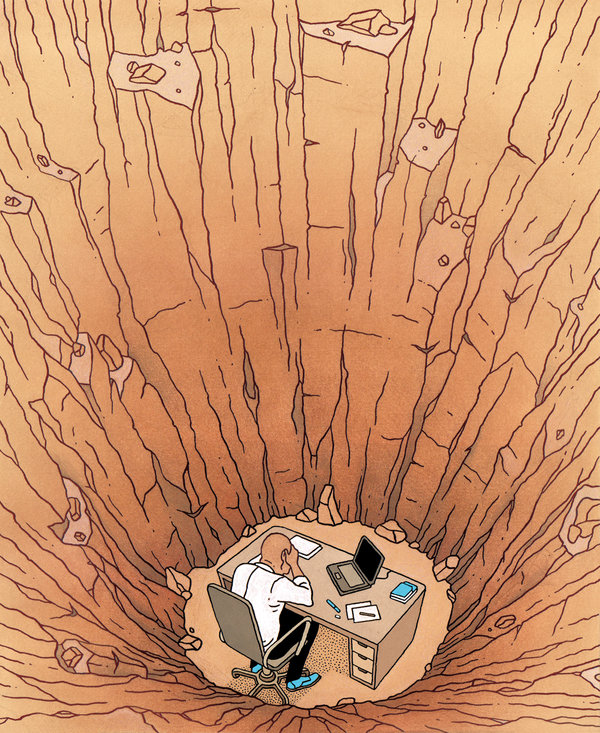 There are plenty of days when Eliza can’t manage to get herself out of the house. On others, she can’t even get out of bed. And in between, she often can’t sleep, can’t concentrate and can’t remember things. She definitely can’t hold down a job. At least not right now.
Eliza, who asked that I not disclose her last name, successfully battled depression for most of her life. She persevered through college and graduate school and worked steadily for more than a decade as a pharmacist. Then, about two years ago, she suffered from an unusually debilitating stretch in which she didn’t respond to antidepressants, and her insurance company refused to pay for experimental treatments that her doctors recommended. Now in her 40s, she has become one of the more than 1.4 million Americans on the federal disability rolls for mood disorders. She also receives Medicaid, food stamps and fuel assistance. “I never wanted a handout,” Eliza told me last month, adding that she has held on to her pharmacy license in the hope that her condition may yet improve. “I would give anything to get out of this and go back to where I was before.” Read more
Read MoreToday I read Psychiatric News, the newspaper of the American Psychiatric Association, and I was drawn to an article about the new APA President, Jeffrey Lieberman, because the front page teaser announced that “he is ‘mad as hell’”.What, I wondered, is he so mad about?
In the article, which reports on Dr. Lieberman’s address at the opening session of the annual APA meeting in May, we learn that he is angry not only about “stigma associated with mental illness” but also “the lack of respect toward psychiatry as a medical specialty”.
Read MoreAn interesting thing has been happening in Canada. In late 2011, the British Columbia Ministry of Health issued a report entitled, “A Review of the Use of Antipsychotic Drugs in British Columbia Residential Care Facilities.” The family of a senior living in such a facility raised the issue of over-medication and, instead of reacting defensively, the provincial government set about studying the prescribing practices of physicians in these residential programs.
Read MoreRecently I had dinner with several primary care physicians who had just read Anatomy of an Epidemic. They had heard of my interest in this book and they asked to discuss it with me.These are physicians I have known for many years and in my opinion they reflect everything that is good in medicine. They are dedicated, caring, and humanistic. But the conversation reflected for me everything that is wrong with the modern practice of medicine. Although there are the ways in which psychiatry is different from the rest of medicine, there are ways in which it is similar and I am not sure we can expect much to change if we do not address some of these similarities.
Read MoreDavid Romprey walked up to me one day when I was in the middle of planning the next new 16-bed facility in a community setting for people who were in our state hospitals in Oregon. Progress was in the making.He asked why I called these places 16-“bed” facilities. Answering matter-of-factly what seemed obvious, I replied that these residences, nicely furnished in pleasant neighborhoods, had 16 beds. Looking me straight in the eye, as he always did, David asked me, “Do you think we’re lying around prostrate all the time?”
Read MoreIn previous posts in this series, I noted that the standard treatment of conditions labeled as schizophrenia (and related disorders) is to start neuroleptics early and to continue them indefinitely. This is based on the belief that untreated psychosis is bad for the brain and that relapse is much higher when the drugs are stopped than when they are continued. The rationale for this approach, and my discussion of the limitations of these assertions, were the topics of previous blogs in this series.
Read MoreFor the past 20 years, there has been a prevailing concern in psychiatry that psychosis is bad for the brain. The notion is that the psychotic process is in and of itself damaging and therefore every effort should be made to curtail this process in order to forestall further damage. This idea heightened the urgency to initiate drug treatment. When I read Anatomy of an Epidemic, this was one of my most pressing concerns; If I suggested to my patients that they pursue other treatments before starting drug treatment, was I helping or harming them?
Read MoreI asserted previously that the impression of short term efficacy tends to be inflated. What I mean by this is that there is a general sense – within my profession and among the general public – that neuroleptic drugs are very effective. They are after all what allowed us to shutter our state hospitals. The folk narrative is that the main problem is not that they do not work but that people do not take them reliably so we should therefore put our efforts into getting people to stay on them.
Read More
I have recently put together a talk in which I summarize my current thinking on the optimal use of neuroleptic drugs, primarily focusing on the treatment of individuals who are experiencing psychotic symptoms. In order to foster conversation on this topic, I will be posting the content of this talk in a series of blogs.
Read More