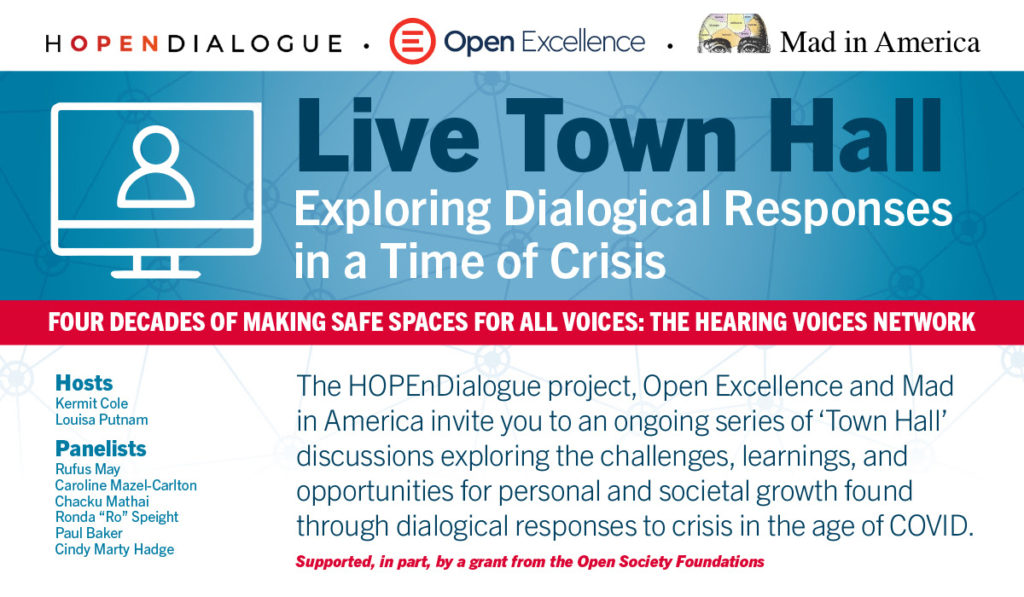

In 1987 Patsy Hage said to her psychiatrist, Marius Romme, “You believe in a God we never see or hear, so why shouldn’t you believe in the voices I really do hear?” This was a reasonable question, Marius realized, and they – along with Sandra Escher – started what became the Hearing Voices Movement. Today the Hearing Voices Network is creating safe spaces for people and their voices – and other experiences perceived as “anomalous” – in 35 countries, expanding the frontiers of meaningful human experience around the world. In recent years the network has begun to support people who wish to ally with their families and social networks to redefine the crises they face together. This “Dialogue in a Time of Crisis” Town Hall will explore how the Hearing Voices Movement, like Open Dialogue, has been building the resources the world needs at this pivotal moment of in our collective history.
Read MoreOpen Path Psychotherapy Collective is a non-profit network of mental health clinicians dedicated to providing affordable psychotherapy to individuals, couples, families, and children in need. Founded in 2012, Open Path has grown tremendously in the last 8 years, expanding to a network of almost 10,000 clinicians and connecting over 35,000 members with therapists across the United States and Canada.
Open Path’s model works by allowing members to join Open Path for a reasonable, one-time membership fee. Members are then able to select an Open Path therapist with whom they would like to begin their therapeutic journey. Members have lifetime access to therapy sessions with an Open Path therapist at greatly reduced sliding scale rates. Therapy sessions can be done in-person or using an online platform.
Therapists who join Open Path join a larger nationwide movement to make mental health care more accessible and are able to directly provide affordable therapeutic services in their local communities. Therapists are also linked with a number of professional benefits that enable them to strengthen and grow their practice.
When the Covid-19 pandemic began to affect U.S. communities in March, we at Open Path had many conversations about the potential mental health impacts of the pandemic. With Americans feeling isolated and anxious due to social distancing requirements, and with the economic downturn that resulted in millions of people losing their jobs and struggling with increased financial insecurity, we anticipated that there would be a greater need for affordable therapy. And while we initially saw a dip in new member enrollment in late March, we are now seeing new member enrollment numbers climb back up to pre-pandemic levels.
At Open Path, we have a unique window into the mental health state of the collective, as we review hundreds of new member applications every week in which people provide a snapshot of their mental health needs. The majority of new member applications we are currently seeing mention the profound effects of the pandemic – members frequently mention lost jobs, challenged relationships, and increased anxiety. Members also mention how mental health needs that had gone unaddressed before the pandemic are now further compounded by the pandemic’s effects. In the upcoming months, we anticipate a large need for more Open Path therapists as our member numbers grow. We are focusing our efforts on recruiting more therapists to meet the impending increase in mental health needs.
Please consider contributing to Open Path to help grow our therapist network. This is a time of immense mental health care need and by donating to Open Path, you directly assist us in meeting that need.
Our gratitude and thanks-
Paul Fugelsang
Executive Director
Open Path Psychotherapy Collective

 Paul Fugelsang, MA, LPC, is the founder and executive director of Open Path Psychotherapy Collective. He received a masters in psychology from Naropa University. He is also the advisor of the Open Path Psychotherapy Collective Fund at the Open Excellence.
Read More
“During the first couple of days of a crisis, it seems possible to speak of things that later are difficult to introduce … It is as if the window for these extreme experiences may only stay open for the first few days. If the team manages to create a safe enough atmosphere through a rapid response and by listening carefully to all the themes the clients speak of, then critical themes can find a space in which they can be handled and the prognosis improves.”
— Jaakko Seikkula, in “Open Dialogues and Anticipations”
by Jaakko Seikkula & Tom Erik Arnkil
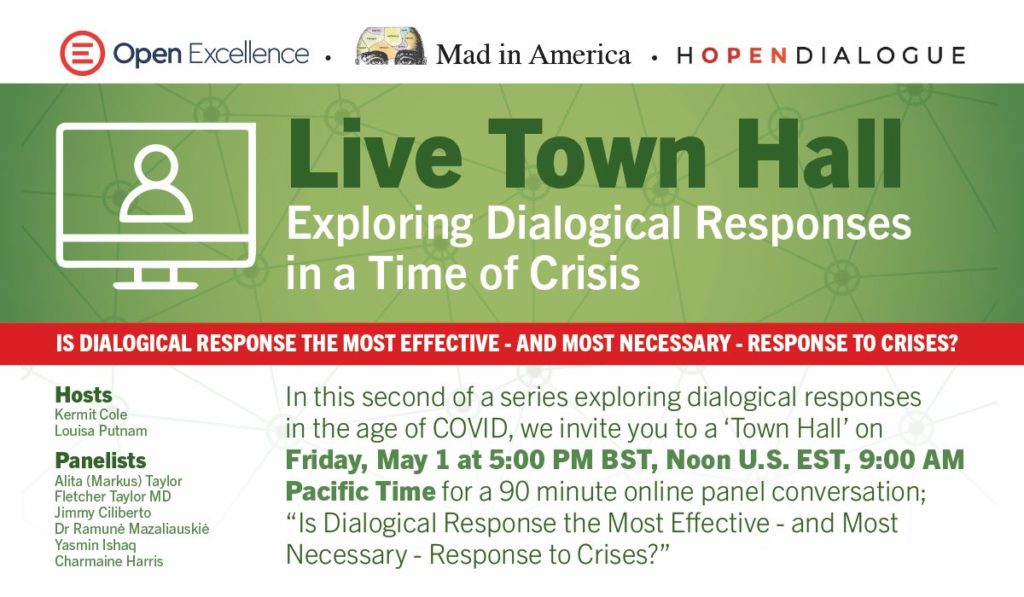
In the spirit of the quote above, Louisa Putnam and I put together the first “Dialogue in a Time of Crisis” town hall meeting in collaboration with Mad in America, HOPEnDialogue, and Open Excellence two weeks ago. We had heard many stories of friends and colleagues adapting their dialogical approaches during the COVID crisis, and we wanted to create a space to gather and learn as we all find a path forward. Over 360 people from 33 countries* joined the panel of Jaakko Seikkula, Rai Waddingham, Andrea Zwicknagl, Richard Armitage, and Iseult Twamley. Since then over 1000 people have watched or listened on YouTube.
Many of those responding spoke of being touched by the respectful atmosphere, with space and time allowed for thoughts to form, and new meaning to arise. This, to me, is the essence of the dialogic approach: finding our way forward in uncertain times by opening up, not ending, the dialogue. It seems paradoxical that when we are most afraid we would let go of the desire for a quick fix. But perhaps the fact that we are relational, social beings means that crisis brings out the need to look to the collective. The fact that so many people found their way to this forum and found comfort in it was, for Louisa and I and all that gathered to participate, very fulfilling. Equally fulfilling as the discussion and the reaction to it was the lively exchange in the chat section, as people from around the world signed on to say hello, meet, comment, and exchange contact info. Similarly, the Q&A was rich with experience and poignant in its immediacy.
Traditional Western psychological approaches to working with voice-hearers have viewed voices, visions, or unusual beliefs or “delusions” purely as pathology or symptoms of psychiatric illness, and typically teach voice-hearers to ignore them. The Hearing Voices approach encourages a sense of curious engagement towards voices, as you would connect with someone you were getting to know. “People frequently do change their understanding [of voices, visions, beliefs] when they have a place where they can explore the context of the experience,” said Cindy Marty Hadge, lead trainer with the Western Massachusetts Recovery Learning Community.
Read More
I hope all of you are well and healthy and staying out of harms way!!! There is little doubt that these are certainly challenging times-the likes of which most of us have never lived through. However as I have learned over my many years of being a psychologist-with crisis comes opportunity if we can keep our wits about us to create it or see it.
As I was putting the final touches on my “Tips” which I had created for my patients- I quickly realized that my family and friends could benefit from them as well- and so I decided to share them with all of you! Even if they help only one person that will be a good thing-and already I have heard that many have found these to be useful.
Read MoreI am trying to find the silver lining every day. I am grateful I have a job I can do from home that contributes to the public health efforts especially during this time that I will refer to here as the “situation”. I am also grateful that I have a home – a roof over my head and a place I can call my own! Hello-right?!? So many don’t have stable housing, employment , health care coverage (oh to be in the US now…) and access to food. And what’s up with the run in the stores on toilet paper (Elaine from Seinfeld – “can you spare a square?”- Uhhmm, No.)?!?. Perhaps the bidet really is a good idea!?

From 2012 to 2018, Parachute NYC offered a “soft landing” for people experiencing psychiatric crisis in New York City. Along with a respite center, Parachute mobile teams consisted of teams of health care professionals, including peer specialists, psychiatrists, social workers, and family therapists, who were each trained in the principles of Open Dialogue and Intentional Peer Support. Open Dialogue, developed in Western Lapland in Finland, espouses a practice of healing through polyphonic (many voices) dialogue within a non-hierarchical network, tolerating uncertainty, and treating every utterance as meaningful and rational. Intentional Peer Support, developed by and for peer specialists, embraces crisis as opportunity, mutual accountability within partnerships, and trauma-informed care. Parachute represented the first instance in which peer specialists were integrated into the Open Dialogue model.
Read MoreThe voices that I hear were very amped up before our historic first facilitator training in Florida. Like a lot of voice-hearers when I experience something new, my experiences can become louder or more intense.
My Voices had questions about whether what we were about to try was going to work. Whether the two-track training we had recently developed, honoring the different needs of groups for voice-hearers and groups for their family members could have the same transformative power as the other trainings we had held across the country.
I decided to visit a peaceful place before the training began and headed to a nearby Japanese garden. As I bought my ticket to the garden, something caught my eye.
Read MoreThe Hearing Voices movement began in Europe in the late 1980s when Marius Romme, a psychiatrist, realized that his training and therapeutic techniques were not helping one of his patients to manage the voices in her head. In listening to Patsy Hage, Romme began to wonder if maybe other voice-hearers might be in a better position to help her than he was. His hunch turned out to be correct, and the Hearing Voices Network (HVN) was co-founded by Romme and Hage in 1987.
The HVN is a peer-to-peer, nonclinical support group based on the radical idea that voice-hearing is not automatically a sign of pathology. Unlike traditional methods that encourage voice hearers not to engage with or listen to their voices, the HVN takes the opposite approach: voice-hearers are encouraged to explore and discover for themselves what their voices mean. The groups also provide social support and acceptance- something that is vitally important given the social distancing and isolation often reported by voice hearers. And the groups offer practical strategies for living with and managing voices.
Read More