“During the first couple of days of a crisis, it seems possible to speak of things that later are difficult to introduce … It is as if the window for these extreme experiences may only stay open for the first few days. If the team manages to create a safe enough atmosphere through a rapid response and by listening carefully to all the themes the clients speak of, then critical themes can find a space in which they can be handled and the prognosis improves.”
— Jaakko Seikkula, in “Open Dialogues and Anticipations”
by Jaakko Seikkula & Tom Erik Arnkil
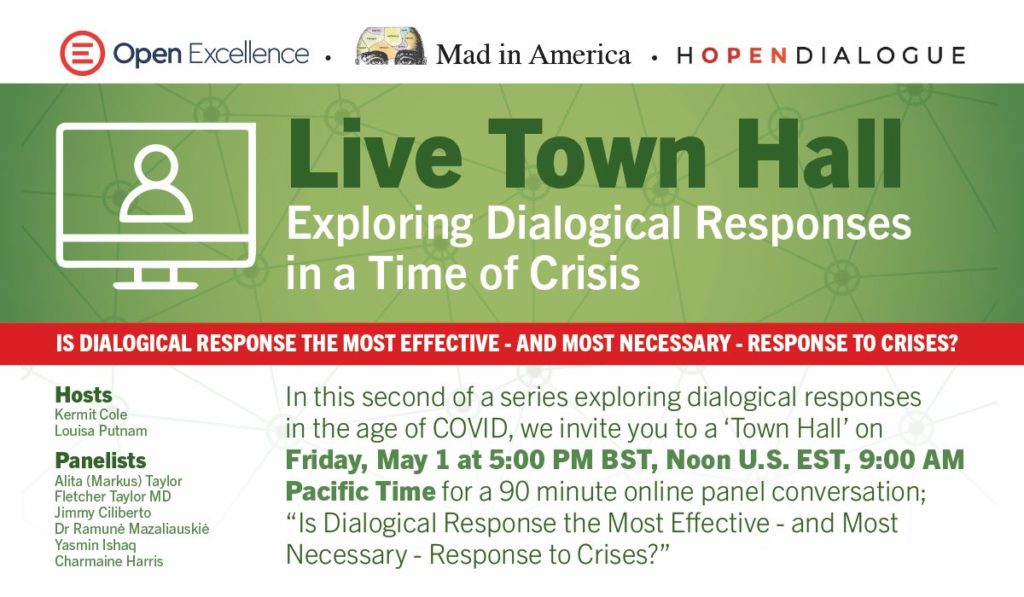
In the spirit of the quote above, Louisa Putnam and I put together the first “Dialogue in a Time of Crisis” town hall meeting in collaboration with Mad in America, HOPEnDialogue, and Open Excellence two weeks ago. We had heard many stories of friends and colleagues adapting their dialogical approaches during the COVID crisis, and we wanted to create a space to gather and learn as we all find a path forward. Over 360 people from 33 countries* joined the panel of Jaakko Seikkula, Rai Waddingham, Andrea Zwicknagl, Richard Armitage, and Iseult Twamley. Since then over 1000 people have watched or listened on YouTube.
Many of those responding spoke of being touched by the respectful atmosphere, with space and time allowed for thoughts to form, and new meaning to arise. This, to me, is the essence of the dialogic approach: finding our way forward in uncertain times by opening up, not ending, the dialogue. It seems paradoxical that when we are most afraid we would let go of the desire for a quick fix. But perhaps the fact that we are relational, social beings means that crisis brings out the need to look to the collective. The fact that so many people found their way to this forum and found comfort in it was, for Louisa and I and all that gathered to participate, very fulfilling. Equally fulfilling as the discussion and the reaction to it was the lively exchange in the chat section, as people from around the world signed on to say hello, meet, comment, and exchange contact info. Similarly, the Q&A was rich with experience and poignant in its immediacy.
From 2012 to 2018, Parachute NYC offered a “soft landing” for people experiencing psychiatric crisis in New York City. Along with a respite center, Parachute mobile teams consisted of teams of health care professionals, including peer specialists, psychiatrists, social workers, and family therapists, who were each trained in the principles of Open Dialogue and Intentional Peer Support. Open Dialogue, developed in Western Lapland in Finland, espouses a practice of healing through polyphonic (many voices) dialogue within a non-hierarchical network, tolerating uncertainty, and treating every utterance as meaningful and rational. Intentional Peer Support, developed by and for peer specialists, embraces crisis as opportunity, mutual accountability within partnerships, and trauma-informed care. Parachute represented the first instance in which peer specialists were integrated into the Open Dialogue model.
Read MoreI am standing here today because – like perhaps many of you – there is a question about Open Dialogue that has been with me for a long time:
WHAT IF? – What if we had had Open Dialogue?
I would like to share a little of my WHAT IF with you.
Read More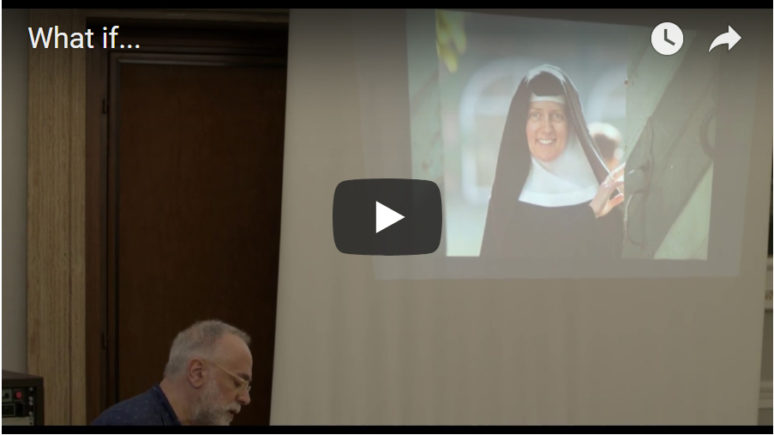
Andrea Zwicknagl’s presentation at the kickoff meeting of HOPEnDialogue, a new Open Dialogue international research collaborative, in Rome, Italy, July 2, 2019. Read by Guiseppe Salamina in her absence.
To learn more and to support this project, please visit https://mental-health-excellence.networkforgood.com/projects/72234-open-dialogue-research-development
Read MoreOn July 2 and 3, 2019, I was privileged to attend the first meeting of the HOPEnDialogue International Research Collaborative in Rome. I attended as a representative of the Board of the Foundation for Excellence in Mental Health Care, along with the Foundation’s President and CEO, Gina Nikkel, and the Foundation’s new Chief Philanthropy Officer, Kevin Aspegren.
The meeting was hosted by the leaders of the project, Raffaella Pocobello and Giuseppe Salamina, and brought together forty representatives from 12 countries, first in an open forum to discuss the goals and overarching strategy of the project, and a second day for the 20 international members of the Advisory Council to address more focused challenges, such as site selection requirements; inclusion/exclusion criteria; training; fidelity; and outcomes.
Read More
Attention Deficit Hyperactivity Disorder (ADHD) is the presence of the behaviors of hyperactivity, impulsivity, and poor attention. The root causes and best solutions for these troubling behaviors will vary from child to child.
Parents concerned about the safety and effectiveness of popular drug treatments can try some promising alternatives with a significantly lower risk of unwanted side effects. Many have found psychotherapy and parent training highly effective in resolving troubling behavior and improving their child’s social skills and relationships with peers.
For some, micronutrient supplements have been life-changing:
The Micronutrients for ADHD Youth study is now accepting new participants, with sites at Oregon Health & Science University, The Ohio State University in Columbus, and University of Lethbridge in Alberta, Canada. Eligible children are age 6-12 and have not been on ADHD medications for two weeks before their participation begins.
Contact lead researcher, Jeanette Johnstone, PhD, at 503-494-3700 or [email protected] if you are within driving distance of Portland, Oregon.
If you are near Columbus, OH, contact E. Arnold, MD at [email protected]
If you are near Lethbridge, Alberta, contact B. Leung, PhD at [email protected]
Read MorePsychiatric Services, a leading US journal, has published two important papers on Open Dialogue. Freeman and colleagues did an extensive literature review and analysis of currently available research. Their paper is accompanied by a commentary by Kim Mueser, PhD, Director of the Boston University Center for Psychiatric Rehabilitation and one of the world’s experts in his field.
Freeman and colleagues begin their paper with a detailed explanation of the criteria for inclusion into their investigation. They identified 23 studies for review. Papers selected were published in English and evaluated Open Dialogue effectiveness using either case study, qualitative, quantitative, or mixed methods. Studies were conducted in Finland, Norway, Sweden, and the US.
As the authors point out, most of the available research comes from the Western Lapland group that developed Open Dialogue (OD). This poses a fundamental source of weakness in the evidence base. Their studies had small sample sizes, there was no control group, and the ratings were not blinded. In addition, there were not consistent methods for either defining or evaluating OD.
Many of us learned of Open Dialogue because of their reported excellent outcomes for individuals who experienced a first episode of psychosis. We are eager to see if these results can be replicated elsewhere. But there are other important questions.
Read MoreThe Fort Collins-based Learning and Self-development Collaborative grant project is midway through supporting its first group of young adults experiencing mood-related distress. It is also actively recruiting for the second group, scheduled to start in late August.
Nearly three-quarters of the young adults in the first group have prior mood disorder diagnoses and have tried psychiatric medications like antidepressants. However, the ineffectiveness and intolerable side effects of the drugs had left them searching for an alternative way forward when they decided to enroll in the Learning and Self-development Collaborative. These young adults are currently medication-free and their outcomes on mood distress, social connectedness, empowerment, and quality of life at six months will be compared to other young adults receiving usual care and daily psychiatric medications in the community.
An initial focus group with participants revealed a number of themes related to young adults’ past experiences with seeking help. Participants discussed feeling frustrated by one-size-fits-all solutions, such as drugs and mindfulness techniques, and invalidated by counselors who failed to connect with their experiences. Lack of information about prescribed drugs was frequently brought up by participants who also shared various stories of “chemical imbalance” and drugs “re-training the brain to relax” told to them by doctors and therapists.
Findings from pre-program focus groups are being used to help inform the content and delivery of educational material in the Learning and Self-development Collaborative.
Read More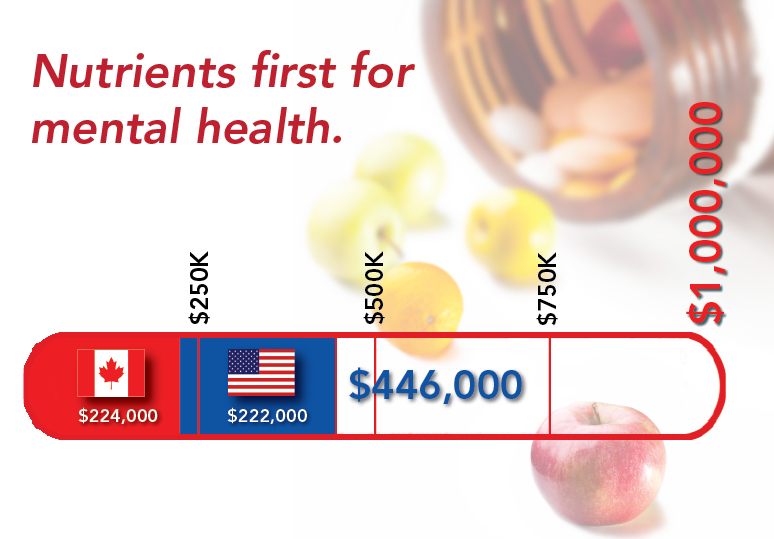 The generosity of people donating to these two charitable funds is heartwarming. Both funds were established to support research in the area of nutrition and mental health, and we are beginning to do just that.
I’m so pleased to announce the following:
Read MoreSir Robin Murray, a distinguished British professor of psychiatry, recently published a paper in Schizophrenia Bulletin titled, “Mistakes I Have Made in My Research Career.” He describes the evolution of his thinking regarding the concept of schizophrenia, including the problems with the neurodevelopmental model, the limitations of the drugs used to treat the condition, and his failure to pay adequate attention to the role of social factors in the etiology of psychotic states. These ideas are not new to anyone who has read Anatomy of an Epidemic. Sir Robin’s ’s paper could be read as a synopsis of Chapter 6, “A Paradox Revealed.”
Read More