

In 1987 Patsy Hage said to her psychiatrist, Marius Romme, “You believe in a God we never see or hear, so why shouldn’t you believe in the voices I really do hear?” This was a reasonable question, Marius realized, and they – along with Sandra Escher – started what became the Hearing Voices Movement. Today the Hearing Voices Network is creating safe spaces for people and their voices – and other experiences perceived as “anomalous” – in 35 countries, expanding the frontiers of meaningful human experience around the world. In recent years the network has begun to support people who wish to ally with their families and social networks to redefine the crises they face together. This “Dialogue in a Time of Crisis” Town Hall will explore how the Hearing Voices Movement, like Open Dialogue, has been building the resources the world needs at this pivotal moment of in our collective history.
Read MoreDear Fellow Dialoguers,
The surprising finding of the creators of “Open Dialogue,” the municipal response to “mental health crisis” that originated in Western Lapland, was that crises—including “psychosis”—tended to resolve when they shifted their focus from “treating” or “fixing” to simply fostering a safe space for dialogue. In a similar spirit, we have striven to provide a safe and welcoming space for for discussion of treatments that, at best, have not helped, and in many cases, caused harm. But we have also striven to change the narrative around how to respond to this pain and these crises.
Read More“During the first couple of days of a crisis, it seems possible to speak of things that later are difficult to introduce … It is as if the window for these extreme experiences may only stay open for the first few days. If the team manages to create a safe enough atmosphere through a rapid response and by listening carefully to all the themes the clients speak of, then critical themes can find a space in which they can be handled and the prognosis improves.”
— Jaakko Seikkula, in “Open Dialogues and Anticipations”
by Jaakko Seikkula & Tom Erik Arnkil
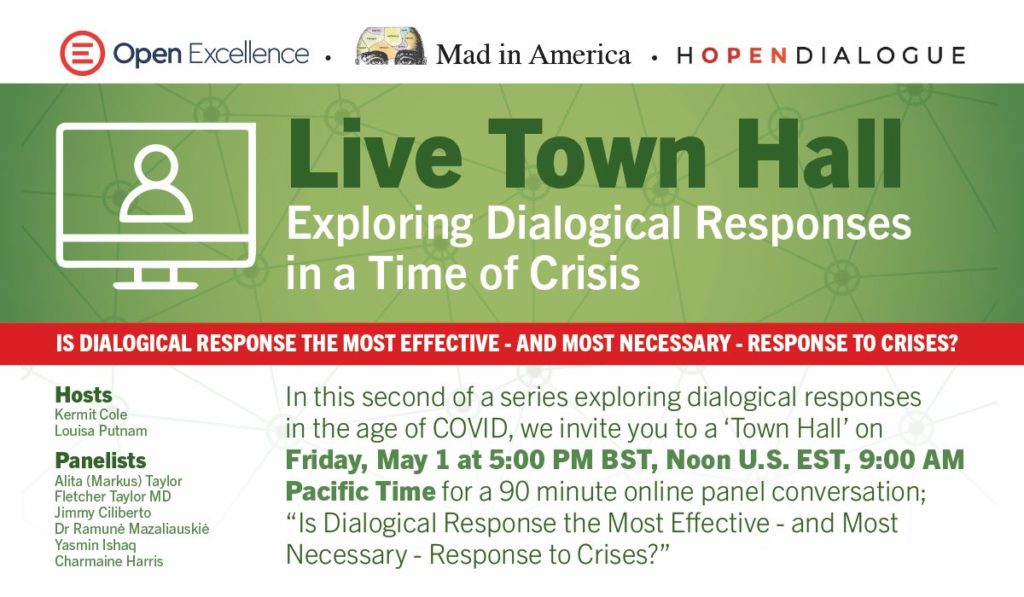
In the spirit of the quote above, Louisa Putnam and I put together the first “Dialogue in a Time of Crisis” town hall meeting in collaboration with Mad in America, HOPEnDialogue, and Open Excellence two weeks ago. We had heard many stories of friends and colleagues adapting their dialogical approaches during the COVID crisis, and we wanted to create a space to gather and learn as we all find a path forward. Over 360 people from 33 countries* joined the panel of Jaakko Seikkula, Rai Waddingham, Andrea Zwicknagl, Richard Armitage, and Iseult Twamley. Since then over 1000 people have watched or listened on YouTube.
Many of those responding spoke of being touched by the respectful atmosphere, with space and time allowed for thoughts to form, and new meaning to arise. This, to me, is the essence of the dialogic approach: finding our way forward in uncertain times by opening up, not ending, the dialogue. It seems paradoxical that when we are most afraid we would let go of the desire for a quick fix. But perhaps the fact that we are relational, social beings means that crisis brings out the need to look to the collective. The fact that so many people found their way to this forum and found comfort in it was, for Louisa and I and all that gathered to participate, very fulfilling. Equally fulfilling as the discussion and the reaction to it was the lively exchange in the chat section, as people from around the world signed on to say hello, meet, comment, and exchange contact info. Similarly, the Q&A was rich with experience and poignant in its immediacy.
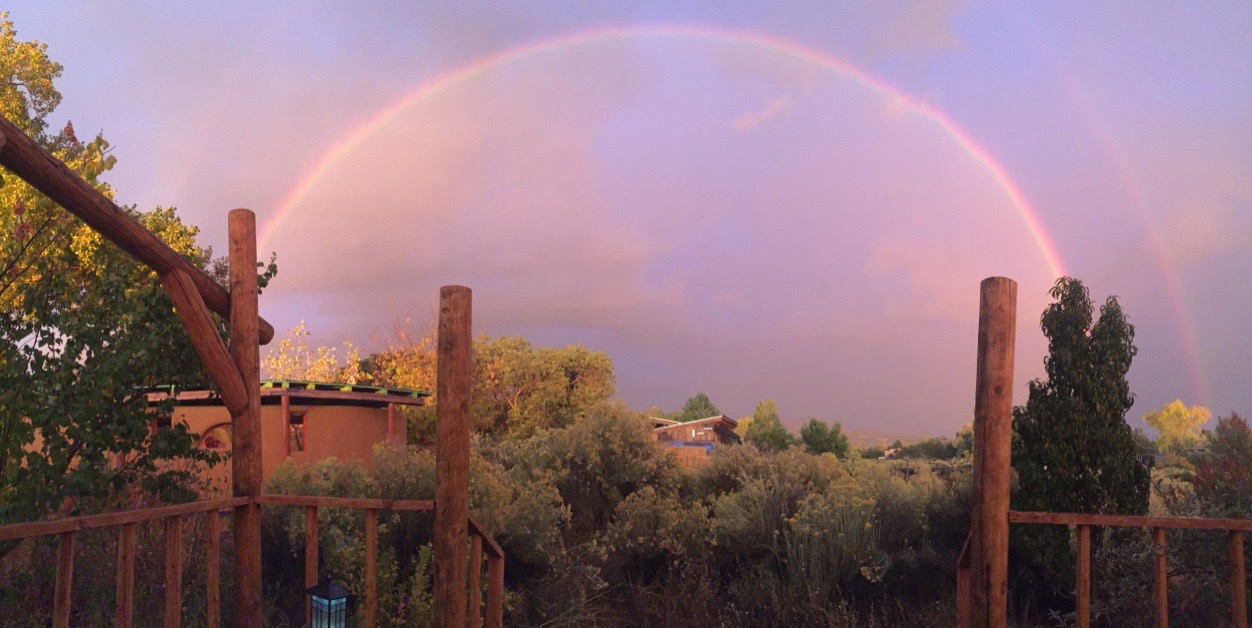
Living in New Mexico means hoping for rain. The state is in drought, with most areas officially in either “extreme” or “exceptional” drought. The soil is full of life waiting for a chance to express itself, but the rare rain forecasts usually promise only “scattered showers nearby,” with the outcome being either clear blue skies or the sight of rain falling elsewhere. New Mexico is also one of the poorest states in the U.S., with more than one in five New Mexicans, and one in four children, living in poverty. We are second in the nation for the prevalence of youth living without connection to work, school, or family. New Mexico ranks high (#7) for people living with serious mental and emotional challenges.
Anyone who has found themselves in the universe of psychiatry knows that it contains some of the “black holes” of science. There is little reliable science on how medications are supposed to ‘work,’ less on what a psychiatric illness is, and none on how to withdraw from the medication. For many, escape from diagnosis and medication is daunting if not impossible. Those who succeed do so for the most part on their own initiative, and therefore any information is anecdotal.
Read More